

Over half of parents may resort to washing children’s school uniforms by hand, amid cost-of-living crisis
- 7 September 2022
New polling from YouGov and charity National Energy Action reveals that low-income parents will struggle to afford to wash their kids’ school uniforms as new term nears.
Share
Low-income parents are resorting to desperate coping tactics when it comes to washing their children’s uniform. That’s because they can’t afford the cost of the energy and water to run their washing machines, according to new polling by YouGov and fuel and water poverty charity National Energy Action.
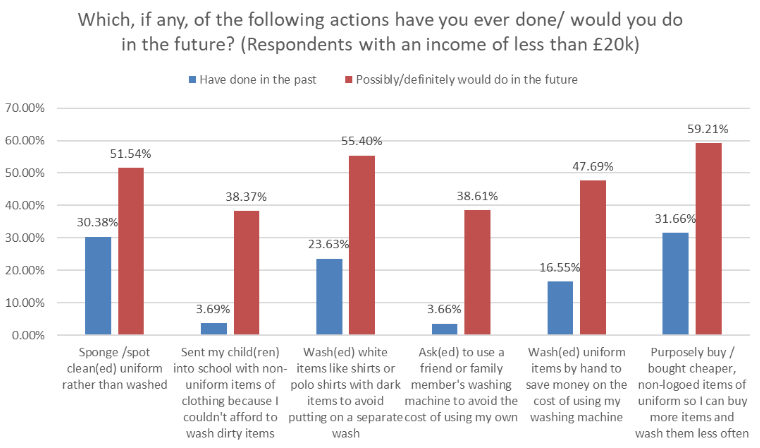
Over one-third (38.37%) of low-income parents with a child going into school in the next academic year could send children into school in non-uniform items because they may not be able to afford the costs of washing dirty items in the future. Nearly four in ten (38.61%) low-income parents could resort to using a friend or family’s washing machine to wash school uniforms.
Project Development Manager (Water Poverty) Jess Cook at fuel poverty charity National Energy Action says:
“As children head back to school for a new term, it might be hard to escape the pictures flooding social media of them lined up in pristine uniforms. But for many low-income parents it’s an image that’s almost impossible to live up to. Amid the cost-of-living crisis, we at National Energy Action have found that parents are being forced into drastic coping tactics including buying cheaper non-uniform items, using a friend or family’s washing machine to save the water and energy costs or even washing them by hand. A clean school uniform may not seem remarkable, but a stained or dirty one, or one with the wrong items can see children getting singled out.”
The cost-of-living crisis is gripping the UK and leading to tough decisions as parents try their best for their children and their household finances.
Almost one-third (30.38%) of low-income parents have previously sponge or spot cleaned uniforms rather than washing them, and over half of parents with school aged children (51.54%) say they could resort to doing this in the future. In the past, almost one-third (31.66%) of low-income parents have purposely bought non-logoed items of uniform, allowing them to buy more items and wash them less often. Now, nearly two-thirds (59.21%) say they possibly would or definitely will do this in the future.
One-fifth (23.63%) of low-income parents have previously washed white items like shirts or polo shirts with dark items to avoid putting on a separate wash, to keep costs down. This academic year, low-income parents doing this could more than double (55.40%) as the impact of the cost-of-living crisis hits.
Jess continues:
“The results of our polling are really troubling. It’s clear that families need more support from the UK government at this time. The return to school is an expensive time of year and it’s happening amid a cost-of-living crisis and right before we are going to see energy bills jump up at the beginning of October. It’s hard to imagine what the impact on children will be.”
What needs to be done
While energy bills are hitting the headlines, given the price cap is predicted to rise leading to an average bill of over £3,000 a year, water poverty is also a big issue for low-income households. Our asks across both utilities include:
- To expedite the process to introduce a single social water tariff, making support fairer for all
- To increase awareness of water affordability support, ensuring that household collections for non-payment are paused during this time
- To target water efficiency measures at homes struggling, or at risk of struggling, to pay their water bills, rather than at the highest users of water
- Top up/double cost of living support
- Reduce the impact of higher energy Standing Charges and policy costs on bills by funding Supplier of Last Resort out of taxation and removing legacy costs on bills.
- Mandate a Social Tariff for energy and new fuel debt support scheme
Share
Subscribe to newsletter
Stay up-to-date with National Energy Action’s work and how we are helping those most in need.