
Annual Conference

Annual Conference


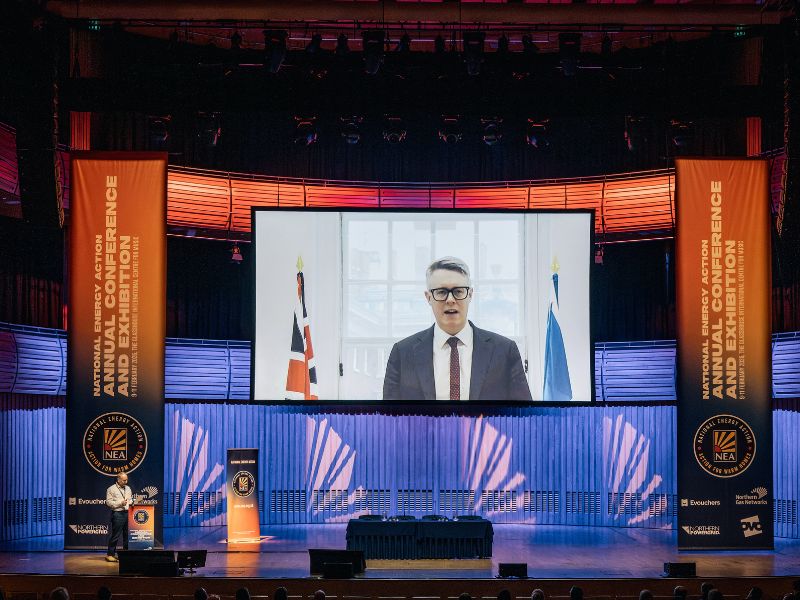
‘Innovation and Change – a new direction for the Fuel Poverty Strategy’ was the theme of National Energy Action’s highly successful 2009 annual conference held at the University of Sussex, Brighton.

The event, supported by EDF Energy, attracted more than 300 delegates representing national and regional government as well as academics, business sector representatives, and advice workers with first-hand knowledge of the lives of the fuel poor.

Parliamentary Under Secretary of State David Kidney MP delivered the conference keynote address in which he insisted that fighting fuel poverty continued to be a priority for Government. Mr Kidney outlined the success of the Warm Front Scheme that has provided assistance to more than two million households since it began in 2000; the scheme’s achievements include the insulation of 460,000 cavity walls and 660,000 lofts insulated as well as installation of 163,000 new central heating systems. The Minister highlighted the Government’s intention of putting social price support on a statutory footing after the voluntary agreement with energy suppliers runs out. Mr Kidney said that the Government recognised the need for greater efforts across Government, working in conjunction with local authorities, delivery partners and the third sector to reduce fuel poverty, especially in view of the current worsening economic climate and rising energy price trends.

He stressed the importance of the Renewable Heat Incentive and the role that feed-in tariffs could play in supplying clean energy cash-back rewards, underlining his commitment to ensure that low-income households do not miss out because of the upfront costs. He stated that any policy proposals to address this were very welcome.

Daron Walker, Director of the Fuel Poverty Review being undertaken by the Department of Energy and Climate Change, provided an update on the progress of the Government’s Fuel Poverty Review.  He confirmed that existing social offerings from energy suppliers would continue as part of the new energy costs support proposals.  In the first phase of this scheme a ‘kernel’ group was identified for priority assistance – those aged 70 or over and in receipt of the guarantee element of Pension Credit; the rationale for this decision was that this would ensure effective targeting of a group whose circumstances were unlikely to alter. Mr Walker also indicated that a section of the funding would be earmarked for discretionary spend to allow support to be directed to other groups.

Sarah Harrison, Senior Partner – Sustainable Development at Ofgem, highlighted the findings from the Energy Supply Probe – stressing that although overall the market was working effectively there were still areas that would have to be addressed.

Ofgem is concentrating on four main areas:

  • Providing clearer information
  • Giving consumers greater confidence
  • A ban on undue discrimination
  • Greater protection for vulnerable and indebted customers

Ms Harrison also discussed the current restructuring that Ofgem has been undergoing, looking at how the regulator can adapt to the changing landscape of the energy market.  The new structure has seen the creation of a sustainable development division as well as a greater focus on network grids.

Teresa Perchard, Director of Policy at Citizens Advice, highlighted the scale of the challenge with 2 million of the 6 million problems dealt with by CAB last year relating to debt; a figure that would inevitably rise as a result of the recession.

Ms Perchard urged Government to ensure that adequate help is given to the working fuel poor. The working fuel poor often live on half the average national income and 70% of them are single with children but current strategies often overlook these households. Teresa focused upon the need for more social marketing to raise public awareness about how to get the most out of their energy companies and called for a major campaign to promote benefits take-up among disabled groups as well as the need to improve quality of service within the Department for Work and Pensions.

Martin Lawrence, Chief Executive of EDF Energy, told conference that he believed that energy suppliers had a crucial role to play on a statutory basis and welcomed the move towards a mandatory social support structure from 2011. Mr Lawrence highlighted future data sharing between Government and suppliers as an important step in identifying the most vulnerable but also recognised the need for this to be balanced with concerns about data protection and equity.

NEA also used conference to launch its proposals for a National Energy Efficiency Scheme; an ambitious national retrofit programme that NEA believes can deliver the Government target to eradicate fuel poverty by 2016.

NEA Director of Communications, Maria Wardrobe, told conference that the scheme represented a radical departure from the current piecemeal approach to delivering energy efficiency, and that this new strategy would see local authorities play a key role in delivering street-by-street energy efficiency advice and practical measures.

William Gillis, Managing Director of Warm Zones, described how the area-based approach works in practice. Warm Zone sis a wholly owned subsidiary of NEA and represents a possible model for wider replication on a national basis.

The Plenary Sessions were supplemented by a range of seminars covering topics including: fuel debt; energy service companies; social tariffs; fuel poverty in Europe; and the role of social marketing in reaching the fuel poor.

The second main session heard EDF Energy’s Director of Specialist Markets Jo Steven outline the company’s social tariffs including its Energy Assist package and its work with partners including the WRVS and the Devon and Cornwall Energy Advice Project.

Dr Gill Owen, a member of the Fuel Poverty Advisory Group, told the session that the introduction of Smart Meters offered the potential for new forms of tariffs and discussed the merits and potential disadvantages of such innovation.

The conference also featured an innovative ‘Dragon’s Den’ style session that saw installers ‘pitch’ their energy efficiency ideas and products to a team of experts.

The third main session featured MPs’ views on future priorities and Brighton Kemptown MP, Dr Desmond Turner, and Simon Hughes MP, Liberal Democrat Shadow Secretary of State for Energy and Climate Change, outlined their personal and party views on energy efficiency and climate change. 

Conference seminar presentations for download 

   TUESDAY 15 SEPTEMBER
  

Opening address
Chair:
•Ruth Thompson OBE, Chair, NEA
Speakers:
• Jenny Saunders, Chief Executive, NEA
• Martin Lawrence, Managing Director Energy Sourcing and Customer Supply, EDF Energy


Session A: Fuel Debt and Consumer Representation
Chair:
• Marcus Clements, Head of Consumer Affairs, Ofgem
Speakers:
• Dhara Vyas, Consumer Focus
Marie Spiers, Energy Advice Development Worker, Plymouth CAB
Ian Hutchinson, Training Officer, NEA

  Session B: Financing Area-Based Initiatives
Chair:
• Steve Ives, DECC
Speakers:
Andy Stephenson, Vice Chair, Carbon Action Network
William Gillis, Managing Director, Warm Zones c.i.c 

  Session C: Recent Changes to Warm Front
Chair:
• Peter Sumby, Director of Operations, NEA
Speakers:
• Ross Armstrong, Delivery Manager, eaga plc
• Hayley Peters, Delivery Manager, eaga plc
• Sian Priest, Fuel Poverty Team, DECC 

  Ministerial Address
• David Kidney MP, Parliamentary Under Secretary of State, DECC
  Plenary 1: Fuel Poverty Review
Chair
• David Green OBE, Vice President, NEA
Panel:
• Martin Lawrence, Managing Director Energy Sourcing and Customer Supply, EDF Energy
• Daron Walker, Director, Fuel Poverty Review, DECC
Sarah Harrison, Managing Director, Ofgem
• Teresa Perchard, Director of Policy, Citizens Advice
• Jenny Saunders, Chief Executive, NEA
• David Kidney MP will join the panel following his address

  Plenary 2: Innovation in Technologies, Tariffs and Social Initiatives and Skills
Chair:
• Lord O'Neill of Clackmannan, Vice President, NEA
Speakers:
Eddie Hyams, Chairman, Energy Saving Trust
Dr Gill Owen, Member of the Fuel Poverty Advisory Group
Jonathan Mackey, Department for Innovation, Universities and Skills
Jo Steven, Director of Specialist Markets, EDF Energy 

  Session D: ESCOs in Development
Chair:
• Christoph Sinn, Policy and Practice Officer, Chartered Institute of Housing
Speakers:
Rod Yeoman, Environmental Projects Manager, Social Housing Sector, Impact Housing
Jerome Baddley, Sustainable Energy Development Manager, Nottingham Energy Partnership

  Session E: Technologies Explored in the Dragons Den
Chair:
• Penny Poyzer, Author and Television Presenter
Dragons:
• Arthur Scott, Head of Technical Services, NEA
• Pam Wynne, Head of Fuel Poverty Team, DECC
• Neil Schofield, Business Development Manager, Worcester Bosch Group
• Bob Carter, Regional Director, Warm Zones c.i.c
• John Lightfoot, Director, Heatking Ltd
• Eric Salomon, Director Energy Field Services, EDF Energy
Entrepreneurs:
Charlie Lamb, Baxi - showcasing Micro CHP
Paul Lovegrove, National Sales Manager, Horstmann Controls Ltd - showcasing Horstmann controls for the disabled
• Adrian Liddell, Enact Energy and Aad De Ruiter, Lexin - showcasing Long Wave Electric Heaters
Lee Marston, Fibre Technology Ltd - showcasing Microtex Fossil Fuel Head Pad
   
  WEDNESDAY 16 SEPTEMBER
  Session F: Innovation in Tariffs and Social Initiatives Explored
Chair:
Valentine Mulholland, Head of Policy Specialist Markets, EDF Energy
Speakers:
• Heather Lowe, Energy Advice Projects Manager, WRVS
• Joanne Carr, Director of Business Development, NEA
Oliver Wright, Campaign Manager, Energy Retail Association


Session G: Commissioning for Improved Health and Wellbeing - Reducing Health Inequalities Associated with Cold Homes
Chair: Malcolm Dove, Operations Manager, NEA
Speakers:
• Terry Blair-Stevens, Health Inequalities National Support Team, Department of Health
Simon Church, Partnership and Development Officer for Health, eaga plc
• Kath McDaid, Regional Co-ordinator, Yorkshire and the Humber, NEA

  Session H: Qualifications and Skills Explored
Chair:
• Joanne Carr, Director of Business Development, NEA
Speakers:
Paul Gaze, National Specialist Team Manager, Construction Sector Skills Council

  Session I: The Big Shift for the Poor - Behavioural and Social Marketing Approaches
Chair:
• Phil Dowling, DECC
Speakers:
David Lynch, Research Officer, NEA
Louise Walden, EDF Energy
Dr Angela Mary Tod, Principal Research Fellow, Centre for Health and Social Care Research, Sheffield Hallam University
Professor Jeff French, Director, National Social Marketing Centre

  Session J: Fuel Poverty Action at a European Level
Chair:
• Virginia Graham, Trustee, NEA
Speakers:
Ron Campbell, Head of Campaigns, Policy, Research and Information, NEA
Mauro Brolis, Cestec (Italy)
Oliver Bajard, Director Vulnerable Customers Team, EDF Energy (France) 


Plenary 3: A Vision for the Future - Innovation Beyond 2012
Chair:
• Chris Norton, BlueRubicon
Speakers:
• Simon Hughes MP, Shadow Secretary of State for Energy and Climate Change (Lib Dem)
• Dr Desmond Turner MP, Brighton Kemptown (Labour)
• William Gillis, Managing Director, Warm Zones
Maria Wardrobe, Director of Communications, NEA

Date last updated: 19/10/2009 8:11am